

or
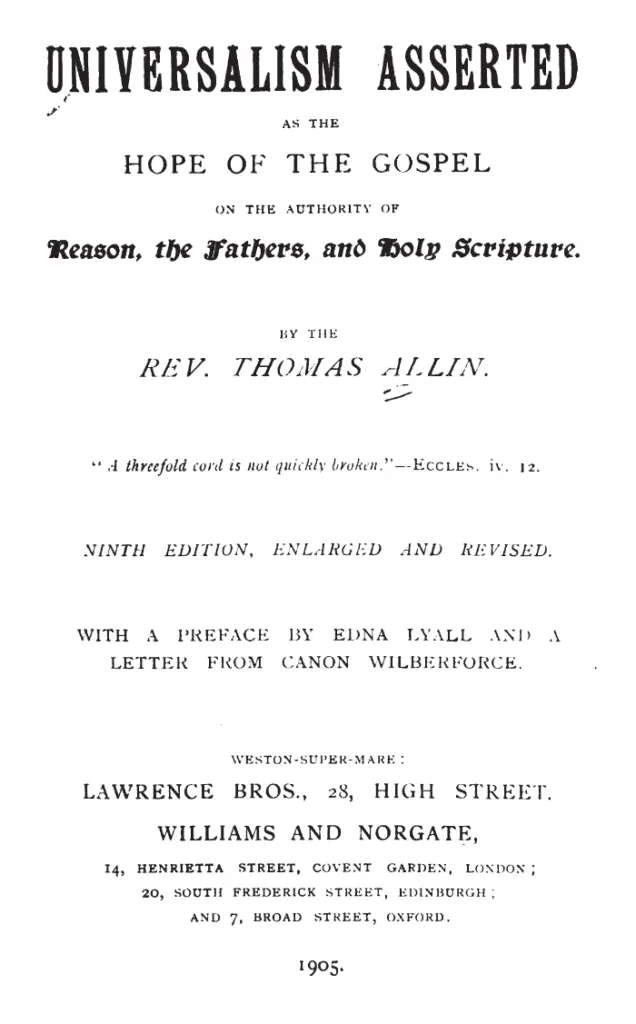
Universalism Asserted
as the Hope of the Gospel on the Authority
of Reason, the Fathers, and Holy Scripture
by
Thomas Allin
Reprint of the Ninth Edition
Published in cooperation with the Saviour of All Fellowship
by the Concordant Publishing Concern
15570 Knochaven Rd. , Canyon Country , CA 91351 , U.S.A.
Transcribed into electronic form by Albert E. Jenke
NOTE - In this issue the references to authors quoted have been given more fully, and the edition used has been stated when making the first quotation. In quotations from the Psalter, the Fathers, as a rule, follow the Septuagint, which numbers differently from the Hebrew, uniting P.c. ix. and x., and also cxiv. and cxv. into one, and dividing cxvi. and cxvii. each into two, thus, e.g., the Psalm quoted as cxix. appears in Patristic writings as cxviii. and so in other cases.
Chapter I -- The Question Stated
Chapter II -- The Popular Creed Wholly Untenable
Chapter III -- The Popular Creed Wholly Untenable (continued)
Chapter IV -- What the Church Teaches
Chapter V -- What the Church Teaches (continued)
Chapter VI -- Universalism and Creation
Chapter VII -- What the Old Testament Teaches
Chapter VIII -- What the New Testament Teaches
Chapter IX -- What the New Testament Teaches (continued)
Chapter X -- Summary and Conclusion
UNIVERSALISM ASSERTED seems to me to fill a great want of the day. A book was needed which should face fairly and thoroughly, the subject of future Punishment, for although there are many works on the subject, they either face one aspect of the matter only, or they are written for scholars only, not for the multitude. Mr. Allin's writing is emphatically writing which can be :understood of the people," and surely his book must kill the false accusation so often made that, those who believe in the ultimate triumph of Christ, and in the Redemption of the world, make light of sin.
Far from being a weak sentimentalist who shrinks from the thought of suffering, the Universalist, as Mr. Allin shows very conclusively in his second and third chapters, is convinced that every sin meets with its just and remedial punishment; he points out, too, how very injurious is the moral tendency of the popular belief in the everlasting existence of evil, - in a purposeless suffering, in an unjust and revolting system of torture. And all this is written calmly and thoughtfully, with a view to meeting the difficulties of those who are in doubt on the subject.
Perhaps the most interesting part of the book is that which shows how throughout the entire history of the Church the belief in universal salvation has been held by many of the best and truest of Christ's followers. And to my mind one of the finest touches is the description given in chapter i., pp. 10-2, of the position of those who, shrinking from the current notions of hell, and dissatisfied with that most unsatisfying theory - Conditional Immortality, take refuge in saying, that nothing can be definitely known, and that they are content to wait in uncertainty.
The sympathetic way in which the writer meets their position, and his fearless exposure of the dangerous vagueness which lurks beneath its apparent humility is beyond praise. How is it possible that those who know the depths of sin and ignorance, those who hear the character of God slandered by believers and unbelievers, those who love the ones who pass unrepentant into the Unseen - how is it possible that they should rest satisfied, while retaining in their hearts even a shadow of a doubt that, "as in Adam all die, so in Christ shall all be made alive ?"
The old merciless teaching is still taught ; there yet remains in many a nursery, as well, alas, as in many a missionary school abroad, a well-known book called "Peep of Day." In this, little children are allowed to read such doggrel as the following: ----
"Now if I fight, or scratch, or bite,
In passion fall, or bad names call,
Full well I know where I shall go.
Satan is glad when I am bad,
And hopes that I with him shall lie,
In fire and chains, and dreadful pains.
All liars dwell with him in hell,
And many more, who cursed and swore,
And all who did what God forbid."
Surely it is time that everyone who believes that the Everlasting Father lovingly, eternally, educates all His children should speak out plainly, and not be ashamed to confess with the Psalmist, "My trust is in the tender mercy of God for ever and ever." -- EDNA LYALL, Eastbourne, 16th December, 1890
PREFACE TO THE SECOND EDITION
The question of questions to which an answer is attempted in the following pages, is essentially this, can Evil triumph finally over Good? If we answer affirmatively with the popular creed, we are practically falling into Dualism; if we reply negatively, we are teaching Universalism. Such are the issues really involved. The more often and the more clearly this is stated as the turning point of the entire controversy about the larger hope, the better for those who write, and for those who read. The Calvinist settled this question by, in fact, affirming that if evil triumphs it is because GOD SO orders, i.e., because GOD decrees to evil an eternal existence; thus saving or trying to save God's omnipotence, but at no less a cost than that of blackening His character, nay, of virtually making HIM a partner in evil. But the popular creed saves neither the omnipotence of GOD, nor yet preserves His character. Sin, the one thing most utterly hateful in His sight, HE tolerates forever and ever, poisoning and defiling His works, and defying His power - satisfied, if in this brief life he cannot have obedience and righteousness - satisfied with endless disobedience and sin hereafter! HE appears before all creation as trying to dislodge sin, only to fail; as sending His Divine Son to save all men in order that HE may return rejected, baffled, vanquished. And so the curtain falls on the great drama of creation and redemption, presenting such a picture as this - a baffled Savior, a victorious Devil, a ruined creation, sin triumphant - and so to continue forever - a heaven wholly base, a hell wholly miserable.
Strong as these words are, they are not strong enough, for the horrors and the contradictions of the popular creed alike defy description. And these horrors are taught, these contradictions are believed in the face of the plainest teaching of Con's two revelations, His primary revelation to our moral sense, His written revelation in Holy Scripture. Of the former and its teachings, it is needless to speak here; of the latter I have spoken at some length, and have tried to show that from its first page to its last the Bible is the story of one who is our Father - one whose 'wrath,' and 'fire,' and 'judgment,' are at once most real, and yet one and all are the expressions of that essential LOVE which HE is - One who being Almighty is sending His Son to assured victory, to reconcile to HIMSELF all things, 'whatsoever and wheresoever they be.' I know how eagerly men strive to save the popular creed by various modifications, by diminishing the number of the lost, by softening their torments, by asserting their annihilation, etc. What are all these but so many tacit confessions that men everywhere feel it impossible to maintain the creed still generally professed? What are they but in fact so many vain attempts to disguise the awful fact of Con's defeat, to hide if it may be the victory of the Evil One? For so long as sin lingers in a single heart, so long as a single child of the Great Parent perishes eternally, whether annihilated, or sent to Hell, so long is the Cross a failure, and the Devil practically victor.
"Shall not the judge of all the earth do right" -- Gen. XVIII.: 25.
THE following pages are written under the pressure of a deep conviction that the views generally held, as to the future punishment of the ungodly, wholly fail to satisfy the plain statements of Holy Scripture. All forms of partial salvation are but so many different ways of saying, that evil is in the long run too strong for God. The popular creed has maintained itself on a Scriptural basis solely, I believe, by hardening into dogma mere figures of oriental imagery; by mistranslations and misconceptions of the sense of the original (to which our authorized Version largely contributes); and finally, by completely ignoring a vast body of evidence in favor of the salvation of all men, furnished, as will be shown, by very numerous passages of the New Testament, no less than by the great principles that pervade the teaching of all Revelation. Again, I write, because persuaded, that however loudly asserted and widely held, the popular belief is at best a tradition - is not an Article of Faith in the catholic Church - is accepted by no general Council, nay, is distinctly opposed to the views of not a few of the holiest and wisest Fathers of the Church in primitive times; who, in so teaching, expressed the belief of very many, if not the majority, of Christians in their days.
Further, I write, because deeply and painfully convinced of the very serious mischief which has been, and is being, produced by the views generally held. They in fact tend, as nothing else ever has, to cause, I had almost said, to justify, the skepticism now so widely spread; they effect this because they so utterly conflict with any conception we can form of common justice and equity.
Therefore of mercy I shall say little in these pages: it is enough to appeal, when speaking of moral considerations, to that sense of right and wrong which is God's voice speaking within us. Indeed, among the many misconceptions with which all higher views of the Gospel are assailed, few are more unfounded than that, which asserts that thus God's justice is forgotten in the prominence assigned to His mercy. This objection merely shows a complete misapprehension of the views here advocated. For these views do in fact appeal to, and by this appeal recognize, first of all, the justice of God. It is precisely the sense of natural equity which God has planted within us, that the popular belief in endless evil and pain most deeply wounds.
These considerations are in fact a complete answer to some other objections often heard. "Why disturb men's minds," it is said, "why unsettle their faith; why not let well alone?" By all means, I reply, let well alone, but never let ill alone. Men's minds are already disturbed: it is because they are already disturbed that we would calm them, and would restore the doubters to faith, by pointing them to a larger hope, to a truer Christianity. A graver objection arises, but, like the former, wholly without foundation in fact. It is said, "By this larger hope you, in fact, either weaken or wholly remove all belief in future punish. meat. You explain away the guilt of sin." The very opposite is surely the truth, for you establish future punishment, and with it that sense of the reality of sin (to which conscience testifies) on a firm basis, only when you teach a plan of retribution, which is itself reasonable and credible. A penalty which to our reason and moral sense seems shocking, and monstrous, loses all force as a threat. It has ever been thus in the case of human punishments. And so in the case of hell. Outwardly believed, it has ceased to touch the conscience, or greatly to influence the life of Christians. To the mass of men it has become a name and little more (not seldom a jest); to the skeptic it has furnished the choicest of his weapons; to the man of science, and to the more thoughtful of all ranks, a mark for loathing and scorn: while, alas, to many a sad and drooping heart, which longs to follow Christ more closely, it is the chief woe and burden of life. But the conscience, when no longer wounded by extravagant dogmas, is most ready to acquiesce in any measure of retribution (however sharp it may be) which yet does not shock the moral sense, and conflict with its deepest convictions. And so the larger hope most fully recognizes at once the guilt of sin, and the need of fitting retribution: nay, it may be claimed for it, that it a/one places both on a firm and solid basis, by bringing them into harmony with the verdict of reason, of conscience and of Holy Scripture.
It is better now for clearness sake, to define that popular view of future punishment, of which I shall often speak. It is briefly this: That the ungodly finally pass into a state of endless evil, of endless torments; that from this suffering there is no hope of escape; that of this evil there is no possible alleviation. That when imagination has called up a series of ages, in apparently endless succession, all these ages of sin and of agony, undergone by the lost, have diminished their cup of suffering by not so much as one single drop; their pain is then no nearer ending than before. Those who hold this terrible doctrine to be a part of the "glad tidings of great joy" to men from their Father in heaven, differ indeed as to the number of the finally lost: some make them to be a majority of mankind, some a minority, even a very small minority. This division of views is instructive, as illustrating the ceaseless revolt of the human heart and conscience against a cruel dogma.
For the Bible is clearly against any such alleviation when read from their own standpoint. The texts on which they rely, if they teach the popular creed at all, teach, just as clearly, that the lost shall be the majority of men. "Many are called but few are chosen." "Fear not, little flock." "Narrow is the way that leads to life and few there be that find it." These are our Lord's own words. They present no difficulty to those who grasp the true meaning of "life," and "death," and "election," the true working of the purpose of Redemption throughout the ages to come.
They present an insuperable difficulty to that very common form of the traditional creed, which seeks to lighten the horror of endless evil by narrowing its range. Indeed, it seems perfectly clear that the popular view requires us to believe in the final loss of the vast majority of our race. For it is only the truly converted in this life (as it asserts), who reach heaven; and it is beyond all fair question, that of professing Christians only a small portion are truly converted; to say nothing of the myriad's and myriad's of those who have died in Paganism. But even waiving this point, the objections to the popular creed are in no way really lightened by our belief as to the relative numbers of the lost and the saved. The real difficulty consists in the infliction of any such penalty, and not in the number who are doomed to it. Nor need we forget how inconceivably vast must be that number, on the most lenient hypothesis. Take the lowest estimate; and when you remember the innumerable myriads of our race who have passed away - those now living - and those yet unborn - it becomes clear that the number of the lost must be something in its vastness defying all calculation; and of these, all, be it remembered, children of the great Parent - all made in His image - all redeemed by the life blood of His Son; and all shut up for ever and ever (words, of whose awful meaning no man has, or can have, the very faintest conception) in blackness of darkness, in despair, and in the company of devils.
Let me next show what this hell of the popular creed really means, so far as human words can dimly convey its horrors, and for this purpose I subjoin the following extracts-
"Little child, if you go to hell there will be a devil at your side to strike you. He will go on striking you every minute for ever and ever without stopping. The first stroke will make your body as bad as the body of Job, covered, from head to foot, with sores and ulcers. The second stroke will make your body twice as bad as the body of job. The third stroke will make your body three times as bad as the body of Job. The fourth stroke will make your body four times as bad as the body of Job. How, then, will your body be after the devil has been striking it every moment for a hundred million of years without stopping? Perhaps at this moment, seven o'clock in the evening, a child is just going into hell. Tomorrow evening, at seven o'clock, go and knock at the gates of hell and ask what the child is doing. The devils will go and look. They will come back again and say, the child is burning. Go in a week and ask what the child is doing; you will get the same answer, it is burning. Go in a year and ask, the same answer comes - it is burning. Go in a million of years and ask the same question, the answer is just the same - it is burning. So, if you go for ever and ever, you will always get the same answer - it is burning in the fire." The Sight of Hell. *** Rev. J. FURNISS, C.S.S.R.
"The fifth dungeon is the red hot oven. The little child is in the red hot oven. Hear how it screams to come out; see how it turns and twists itself about in the fire. It beats its head against the roof of the oven. It stamps its little feet on the floor." - ib. "Gather in one, in your mind, an assembly of all those men or women, from whom, whether in history or in fiction, your memory most shrinks, gather in mind all that is most loathsome, most revolting * * * conceive the fierce, fiery eyes of hate, spite, frenzied rage, ever fixed on thee, looking thee through and through with hate *** hear those yells of blaspheming, concentrated hate, as they echo along the lurid vault of hell; everyone hating everyone *** Yet a fixedness in that state in which the hardened malignant sinner dies, involves, without any further retribution of God, this endless misery." Sermon by the Rev. E.B. Pusey DD.
"When you die your soul will be tormented alone; that will be a hell for it: but at the day of judgment your body will join your soul, and then you wilt have twin hells, your soul sweating drops of blood, and your body suffused with agony. In fire, exactly like that we have on earth, your body will lie, asbestos like, for ever unconsumed, all your veins roads for the feet of pain to travel on, every nerve a string, on which the devil shall for ever play his diabolical tune of hell's unutterable lament." Sermon on the Resurrection of the Dead. *** Rev. C. H. SPURGEON.
Awful as are these quotations, I must repeat that they give no adequate idea at all of the horrors of hell; for that which is the very sting of its terrors -their unendingness - is beyond our power really to conceive, even approximately, so totally incommensurable are the ideas of time and of endless duration.
It will be said, "we no longer believe in a material hell - no longer teach a lake of real fire." I might well ask, on your theory of interpreting Scripture, what right have you so to teach? But let me rather welcome this change of creed, so far as it is a sign of an awakening moral sense. Yet this plea, in mitigation of the horror your doctrines inspire, cannot be admitted; for when you offer for acceptance a spiritual, rather than a material flame, who is there that cannot see that the real difficulty is the same, in either case. If evil in any form is perpetuated then the central difficulty of the traditional creed remains.
Merely to state the traditional doctrine in any form, is to refute it for very many minds. So deeply does it wound what is best and holiest in us; indeed, as I shall try to show further on, it is, for all practical purposes, found incredible, even by those who honestly profess to believe it. This terrible difficulty, felt and acknowledged in all ages, has been largely met for the Roman Catholic, by the doctrine of Purgatory, which became developed as the belief in endless torment gradually supplanted that earlier and better faith, which alone finds expression in the two really catholic and ancient creeds, faith in Everlasting Life. How immense must have been the relief thus afforded, is evident, when we remember that the least sorrow, however imperfect, the very slightest desire for reconciliation with God, though deferred to the last moment of existence, was believed to free the dying sinner from the pains of hell, no matter how aggravated his sins may have been. Among the Reformed Communions this difficult y was met, no doubt, by a silent incredulity - often unconscious - yet ever increasing, on the part of the great majority: indeed, some divines, have at all times, both in England and on the Continent, openly avowed their disbelief in endless torments. This growing incredulity has found, in our day, open expression, in a remarkable theory, that of conditional immortality (itself a revival of an earlier belief). This doctrine, briefly stated, teaches that man is naturally mortal, that only in Jesus Christ is immortality conferred on the righteous - that the ungodly shall be judged, and, after due punishment, annihilated.
Of this dogma I shall at once say, that, while it degrades man, it fails to vindicate God. "It is that most wretched and cowardly of all theories, which supposes the soul to be naturally mortal, and that God will resuscitate the wicked to torment them for a time, and then finally extinguish them. I can see no ground for this view in Scripture but in mistaken interpretations; and it does not meet the real difficulty at all, for it supposes that evil has in such cases finally triumphed, and that God had no resource but to punish and extinguish it: which is essentially the very difficulty felt by the skeptical mind. I have called it cowardly, for it surrenders the true nobility of man, his natural immortality, in a panic at an objection; and like all cowardice, fails in securing safety." Donellan Lectures, QUARRY.
Further, let me reply thus; I believe in one God the Father Almighty, who “wills not the death of a sinner." If, then, even one sinner die finally, God's will is not done, i.e., God is so far defeated and evil victorious. Annihilation is the triumph of death over life: it is the very antithesis to the Gospel, which asserts the triumph of Christ over every form of death. It is strange indeed that able men, who write elaborate treatises advocating this view, should overlook the fact, that all schemes of partial salvation involve a compromise with evil on God's part.
No less strange is the assertion that the moral sense is not shocked by God, who is absolutely free, yet forcing the gift of life on those whom He knows to be in fact destined to become the prey of evil so completely, that they either rot away of sheer wickedness; or, being hopelessly corrupt, are extinguished by their Father.
Death nowhere in Holy Scripture implies annihilation, for earthly destruction is, especially in the case of the Old Testament, that which is denoted by the term, death: but as a rule this term has a wider significance, and one far deeper. Nay, as I hope to point out, (ch. vi. on death,) there is in Scriptural usage, especially in the New Testament, a deep spiritual connection between death and life; death becomes the path to, and the very condition of, life.
Further, this theory wholly breaks down in practice. So far from "perishing" implying final ruin, Christ came specially to save that which has "perished," - to apololos, the "lost," "ruined," "destroyed ;" the original term is the same which is often translated "destroy," and on which the theory of annihilation is so largely built. The same word occurs in S. Luke xv., and there is applied to the Sheep, the Coin, the Prodigal Son - all of which are thus 'destroyed," "lost," and yet finally saved. In S. Matt.X 39, xvi. 25, to "lose" (destroy) one's life is stated as the condition of finding it. So Christ is sent to save the "lost" (destroyed) sheep of Israel . So Sodom and Gomorrha are destroyed, and yet have a special promise of restoration. - Ez. xv. 53:5 Take the Antediluvians. After they had "died" in their sins they were evangelized by Christ in person. - I S. Pet. iii. 19. Hence the unanswerable dilemma, either all these are annihilated, or you must give up that sense of "perishing" on which the theory is based.
Probably I have said enough, but yet a very grave difficulty remains. This theory stands in hopeless conflict with the promises to restore all things, to reconcile all things through Christ, which abound in Scripture; nay, which form the very essence of its teaching when describing Christ's empire. It seems amazing that able men are found capable of maintaining that a reconciliation which is described as coextensive with all creation, Col. i. 15-20, can be equivalent to restoring some (or many) things, only after annihilating, as hopelessly evil, all the rest.
Another view adopted by a number, probably extremely large, and increasing, differs altogether from that last stated. Those who hold it have had their eyes opened to the fact, that the New Testament contains very many, long neglected, texts which teach the salvation of all men. They have also learned enough to have their faith gravely shaken in the popular interpretation of the texts usually quoted in proof of endless pain. The theory of conditional immortality fails to satisfy such men. They see that it is altogether unsuccessful in meeting the real difficulty of the popular creed, i.e., the triumph of evil over good, of Satan over the Savior of man, and therefore over God. They perceive, too, the narrow and arbitrary basis on which it rests in appealing to Holy Scripture. And so they decline to entertain it as any solution of the question, and say, "We are not able definitely to accept any theory of the future of man, because we do not see that anything has been clearly revealed. Enough has been disclosed to show to us that God is love, and we are content to believe that, happen what will, all will ultimately be shown to be the result of love divine."
It is impossible to avoid sympathy with much of this view at first sight, but only then; for when closely examined it is seen to be open to the charge of grave ambiguity, or far worse. It may mean that in the future God will act as a loving human parent would, and then, I reply, this is precisely the larger hope. Again, it may mean a very different and very dangerous thing. It may mean that at the last my ideas of right and wrong will undergo a complete change- that the things which I now pronounce with the fullest conviction to be cruel and vile, will at that day seem to be righteous and just, and that thus God will be fully justified though He inflict endless torment. But take this statement to pieces and see what it really means. It means, in effect, practical Skepticism. It means blank Agnosticism. This is easily shown. For what this view really tells me is that my deepest moral convictions are wholly worthless, because that which they declare to be cruel and revolting, is right and holy, and will so appear at the last. But if this be so, then I have lost my sole measure of right and wrong. What is truth or goodness, I know not. They cease to be realities; they are, for all I know, mere phantoms. Religion, therefore, is impossible. Conscience ceases to be a reliable guide. Revelation is a mere blank, for all revelation presupposes the trustworthiness of that moral sense to which it is addressed. Thus the above plea, plausible as it seems, is wholly ambiguous, and does in fact lead either to the larger hope, or to mere unbelief.
In opposition to both these theories stand the views here advocated, which have been always held by some in the Catholic Church; nay, which represent, I believe, most nearly its primitive teaching. These views are, I know, now widely held by the learned, the devout, and the thoughtful in our own and in other communions. Briefly stated, they amount to this :-That we have ample warrant, alike from reason - from the observed facts and analogies of human life - from our best and truest moral instincts - from a great body of primitive teaching - and from Holy Scripture itself, to entertain a firm hope that God our Father's design and purpose is, and has ever been, to save every child of Adam's race.
Therefore I have called this book, "Universalism Asserted." But let there be no mistake. I assert this not as a dogma, but AS A HOPE: as that which after many years of thought and study seems to me to be the true meaning of Holy Scripture, as it is certainly in harmony with our moral sense, and has been taught by so many saints in the early Church.
The term, "Universalism," may not, indeed, commend itself to some, but I retain it advisedly. It seems to convey an essential truth. "The kingdom of Christ *** is in the fullest sense *** universal." - Lightfoot.
It is an universal remedy to meet an universal evil. While sin is universal, and sorrow and pain universal, shall not our hope be universal too? Shall not life be as universal as death, and salvation as universal as sin?
Can we even think of a divine life and a divine love as other than in their very essence universal?
"These questions * * educated men and women of all classes and denominations are asking, and will ask more and more till they receive an answer. And if we of the clergy cannot give them an answer, which accords with their conscience and reason * * then evil times will come, both for the clergy and the Christian religion, for many a year henceforth." --- Canon KINGSLEY.- Water of Life.
"The answer which the popular theology has been tendering for centuries past will not be accepted much longer * * * I disclaim any desire to uphold that theology which I have never aided in propagating."-- Rev. Dr. LITTLEDALE. - Contemporary Review.
At the outset let me protest against the common and ignorant prejudice that connects Universalism with lax views of sin or of dogma. As to the first, I shall have occasion bye and bye to point out, that no system so effectually affirms God's hatred of sin, as that which teaches that He cannot tolerate its existence for ever. Again, as to the second, I shall largely base my argument for Universalism on the fullest acceptance of the great catholic verities. A narrow Catholicism is a contradiction in terms.
To this point I shall return, confining myself here to the remark that a partial salvation aims a blow at both the Incarnation and the Atonement. For a vital part of the Incarnation is the taking of the race of man, as an organic whole, into God through Jesus Christ, the second Adam. But with this fundamental idea, a partial salvation is. in hopeless contradiction. No less vital is the blow aimed by the popular creed at the Atonement. First it dishonors the Cross by limiting its power to save, to the brief moments of earthly life. Further, it virtually teaches that the Cross is a stupendous failure. This is easily shown. For plainly that which misses its end is a failure. And if the end aimed at be noble, then in proportion is the failure greater and vital. But the scriptural evidence is overwhelming, that the object of Christ's death was to save the world. "The Father sent the Son to be the Savior of the world." He came that the world through Him might be saved; i.e., the world in all its extent, not a part of it, however large. If, then, this end be not gained, if the world be not in fact saved, the Atonement is so far a failure. Disguise the fact as men may, the dilemma is inevitable. Answer, or evasion, there is none.
The next step will be to state more in detail the various considerations that render it impossible to accept the traditional view of future punishment; or any modification of it which teaches the endless duration of evil, moral or physical, in even a solitary instance; a fact essential to bear in mind, when I refer to the traditional creed, or the popular creed anywhere in this book. My first appeal shall be to that primary revelation of Himself which God has implanted in the heart and conscience of man. I am merely expressing the deepest and most mature, though often unspoken, convictions of millions of earnest Christian men and women, when I assert, that to reconcile the popular creed, or any similar belief in endless evil and pain, with the most elementary ideas of justice, equity, and goodness (not even to mention mercy), is wholly and absolutely impossible. Thus this belief destroys the only ground on which it is possible to erect any religion at all, for it sets aside the primary convictions of the moral sense; and thus paralyses that by which alone we are capable of religion. If human reason be incompetent to decide positively that certain acts assigned to God are evil and cruel, then it is equally incompetent to decide that certain acts of His are just and merciful. Therefore if God be not good, just, and true, in the human acceptation of these terms, then the whole basis of revelation vanishes. For if God be not good in our human sense of the word, I have no guarantee that He is true in our sense of truth. If that which the Bible calls goodness in God should prove to be that which we call badness in man, then how can I be assured that, what is called truth in God, may not really be that which in man is called falsehood? Thus no valid communication - no revelation - from God to man is possible; for no reliance can, on this view, be placed on His veracity.
"We dare not," says the Bishop of London, "let go the truth, that the holiness, the goodness, the justice, the righteousness, which the eternal moral law imposes on us as a supreme command, are identical in essential substance, in our minds and in His." - Bampt. Lect.
"We dare not!" Why? Precisely because, if we do, the foundations of religion collapse - perishing as the moral order perishes. We are worshipping once more the unknown God. Mere skepticism is our sole refuge. We have lost our standard of right and wrong, and are wandering in a pathless desert, creed less, homeless, hopeless, mocked all the while by phantoms of virtues that are probably vices, and of vices that are probably virtues. For let me repeat that if goodness in becoming infinite turns into evil - if infinite love may be consistent with what we call cruelty - then, for all we know, truth may turn into falsehood, justice into flagrant wrong, light into darkness. Therefore, we dare not let go the truth that in our moral nature we have a true revelation of the divine mind, i.e., that the ideas of right and wrong are in their essence the same in our minds and in God's- that they are true universally; as true beyond the grave as here and now. But if so, then that which so flatly contradicts all our deepest moral convictions, as does the dogma of endless sin (a dogma which, however modified, no imaginable hypothesis can reconcile with either justice or mercy) must be absolutely false, and in teaching it we are but libeling God.
Further, if endless evil may be defended, in even a solitary case, it may be defended logically in every case. This follows strictly from the ground taken by advocates of the traditional creed. "They say we cannot judge what is cruel or the reverse on God's part." Be it so, for argument's sake. Then it follows, that if every human being fall under the sway of evil foe ever, and God be thus left face to face with an universal Pandemonium, then we should have no right even to murmur, for we have right to judge, having no faculties adequate to the task. But in fact we are not alone justified in arguing from our own minds to God's; we are forced to do so, or to remain agnostics. It is from our minds that we gain a knowledge of the divine mind, from the working of our intelligence and will that we gain a knowledge of God's will and intelligence. This is the pathway God has traced, the foundation He has laid. And there is no other possible.
We smile at the ignorant savage who mutilates his body, thinking thereby to please his God. Are not we far worse who think to please our God by mutilating our noblest part, and to hear him better by silencing his voice in us? But our opponents do not forbid the argument from our nature to God: they only forbid the argument from what is best in our nature to His. They are ready to ascribe certain base qualities of humanity to God. Because we delight in vengeance, so does God. Because we are cruel, God must be so. But eighteen hundred years have not taught the mass of Christians to credit their heavenly Father with even so much love for His children, as a frail woman can feel for her offspring.
The mode in which the ordinary creed does its hateful work of hardening the skeptic, and saddening the most devout, may be shown by two brief extracts . "All the attempts yet made," says a stern moralist, "to reconcile this doctrine with divine justice and mercy, are calculated to make us blush, alike for the human heart that can strive to justify such a creed, and for the human intellect that can delude itself into a belief that it has succeeded in such justification."
"Nothing," says the late General GORDON , "can be more abject and miserable than the usual conception of God *** Imagine to yourself what pleasure it would be to Him to burn us, or to torture us. Can we believe any human being capable of creating us for such a purpose? We credit God with attributes which are utterly hateful to the meanest of men *** I say that Christian Pharisees deny Christ *** A hard, cruel set they are, from high to low. When one thinks of the real agony one has gone through in consequence of false teaching, it makes human nature angry with the teachers who have added to the bitterness of life."
The popular view is familiar, and most men do not realize its true bearing, or the light in which it really presents the character of God. But consider how this dogma of endless evil must strike an inquirer after God, one outside the pale of Christianity, but sincerely desirous of learning the truth. There are such men - there are many such. You tell this inquirer that God is not Almighty only, but all good; that God is indeed love; that God is his Father. But these terms are words without any justification at all, if they have not their common ordinary sense when applied to God.
Such a man will say, you tell me God is good, but what acts are these you assign to Him? He is a father; but He brings into being myriads of hapless creatures, knowing that there is in store for them a doom unutterably awful. He calls into existence these creatures, whether they will or no; though the bottomless pit is yawning to receive them, and the flames ready to devour them. The question is not, whether they might have escaped; the real questions are, do they in fact escape? and does He know that they will not escape? and, knowing this, does He, acting freely, yet create them? And you assure me that this Great Being is Almighty, is Love essential, is the Parent or the Creator (here the terms are practically equivalent) of every one of these creatures, who are doomed and damned. What fair answer do you propose to give to these questions if addressed to you? I may put the inquiry in the words of a well-known poet.
A lost soul asks-
"Father of mercies, why from silent earth
Did You awake, and curse me into birth?"
--- Night Thoughts.
Pressed by the irresistible weight of these arguments many take refuge in ambiguous and evasive phrases, e.g., "Be sure God will do the best He can for every man." Ambiguous and evasive words, I repeat, as used by the advocates of endless torment and evil. For if they really mean that the best an Almighty Being can do for countless myriads of His children is to bestow on them, - practically to force on them - whether they will or not, an existence, stained with sin from the womb, knowing that in fact this sin will ripen into endless misery - then such phrases as the .above are but so much dust thrown in our eyes, they are as .argument beneath refutation. And if they do not mean this, such pleas are worthless as a defense of the ordinary creed. If endless misery is the certain result, known and foreseen, of calling me into existence, then to force on mc the gift of life, is to do for me not the best, but the worst possible.
Others take refuge in the vain assertion that the larger hope implies the escape of the wicked from all punishment, and places the sinner on a level with the saint. Let me once for all reply that no statement can be more unfounded. For the very method of healing the finally impenitent, as taught by the larger hope, is the severity of the divine judgment, is that consuming fire, which must burn up all iniquity. Thus the larger hope is especially bound to teach for the obstinate sinner the certainty of retribution, for in Cod's judgments it sees the mode of cure (see chap. vi.), the mode in which the grace of the Atonement often reaches the touched heart. Thus, unrepented sin leads to awful future penalty, to penalty proportioned to the guilt of the sinner and continued till he repent. The larger hope - so falsely called "sentimental " -thus not merely accepts, but emphasizes for the ungodly the dread warning of wrath to come - of the fires of Gehenna - for in these it sees not a wanton revenge, but at once a just retribution; and a discipline that heals the obstinate sinner.
Again, it is said, that perhaps the flames of hell may be needed to terrorize some far distant sinful orb; that rebels against God in some other planet may read, by the light of hellfire, the dangers of sin. Yes, it has been gravely alleged that a Being, Whose name is Love, will light, and keep alight through unending ages, a ghastly living torch for such a purpose as this - a torch- each atom of which is composed of a lost soul, once His child, once made in His image, once redeemed by the Cross of His dear Son!
You know this has been taught, and yet you actually complain that men are skeptical, and that thoughtful artisans reject such a creed with scorn. Many, too, but in vain, seek to mitigate the just horror and loathing which the popular creed inspires, by saying that the torments of hell are not material but spiritual; and by asserting further (contrary to the plainest teachings of experience) that somehow the majority do really turn to God in this life, or at the last moment of half conscious existence. I say nothing of the bribe thus offered to the selfish instincts of the majority, by the assurance that somehow they will shuffle into heaven, and that only a worthless few perish. But this shabby plea is (1) false from the standpoint of those who teach it (p. 4), and (2) does not, if true, even touch the central difficulty of the popular creed. For whether our Father permits (to use the softest term) the endless misery and evil of countless myriads upon myriads of His own children, or of thousands only; whether hell receives fifty, or five, or only one per cent of the sons of God, of the brothers of Christ Jesus: and again, whether its torments are applied to their bodies, or to their spirits, all these are points that, however decided, do not even touch the central question, i.e., can evil be stronger than God, ever, under any circumstances? - can a Father permit the endless, hopeless, sin and woe of even one of His children, and look on calmly for ever and ever unmoved and unsympathising - can the Bible be mocking us when it teaches a restitution of all things, and that a time is coming when God shall be "All in All."
Some will, no doubt, say that we have no right to measure God's ways by our private judgments, no right to seem to dictate what He will or will not, can or cannot do. I reply that this objection rests on a complete misapprehension. We do not presume to discuss what God, in the abstract, can or cannot do, still less to dictate to Him. The argument employed in these pages is open to no such objection as the above, for it is simply this - that God has both in His primary revelation of Himself to our moral sense, and in His written word, distinctly and emphatically declared against the doctrine of endless evil. Because God has so spoken, we therefore speak. Others again assert that endless misery is sufficiently accounted for by saying that it comes as the natural result of sin, and not as arbitrarily decreed. I am wholly unable to see how this in the very least alters the divine promise to restore all things, or annuls the work of Christ, which is to "put away sin by the sacrifice of Himself." Surely the more natural the tie between sin and misery, the more assured is the destruction of both; for the closer the bond, the more certain it becomes that to put away, i.e., to abolish (Heb. ix. 26) the one is to abolish the other.
The law of continuity, however, it is said, forbids Universalism. Those who go on to the close of life impenitent must be presumed to continue impenitent hereafter. But why? They will continue so only if the forces working for impenitence hereafter are stronger than the forces making for good. And the conditions under which these forces will work in a future state, will certainly be very unlike, those now obtaining, and very much more favorable to conversion.
"In that other life there will be no room for unbelief, when Christ has been seen. Then that great source of evil which is in the flesh, will be at an end; no inner lust will remain: no external food for vice: no temptation to concupiscence, to ambition, to avarice, will survive. How then the lost can for ever cling to sin, unless divinely hardened, I fail to see." - BURNET De statu mort.
I may add that beyond the grave illusions will cease. Here men are blinded; and most often, if not always, follow evil not as being evil, but as a fancied good. "Had they known, they would not have Crucified the Lord of Glory," - I Cor. ii. 8 - pregnant words. In fact, this objection seems but a roundabout way of saying that the devil is stronger in the long run than God. Surely the presumption, even apart from a revealed promise of the restoration of all things is, that evil being an intruder and an alien, and the world being under divine government, this government can never cease working, till order and right wholly replace disorder and wrong. Why are we to assume that God means to share His throne for ever with the powers of evil, or that He has, in any case, exhausted His means of cure in the present brief life?
In fact, we totally err in our estimate of the relative strength of good and evil when we treat the latter as though it were on a par with the former in fibre, in duration, or in essence. For this there is no shadow of excuse: it is dualism thinly disguised. It is this degrading heresy to which the traditional creed is ever tending. I deny, then, any presumption that because evil has gone on for years it will go on always. The logical and moral presumption is precisely the other way, viz., that the weaker will in the long run yield to the stronger: the usurper to the lawful owner: the evil one to God. Further, the facts of the physical and spiritual worlds are alike fatal to any such narrow theory of continuity. What is the Creation but a striking breach of continuity? So, too, was the Deluge; so is every earthquake, etc. And it is worth careful noting that the only appeal in Scripture to the laws of physical continuity comes from the unbeliever, and is made in the interests of skepticism. - 2 Pet. iii. 4. I admit that there probably is a higher continuity than any we can at present trace. The very breaks in the established order may be but parts of a higher order, and may thus range themselves on the side of and not against a true continuity. But it is impossible to argue that, merely because a certain order of things continues for long unbroken, it will therefore go on for ever. If so, there could be no Creation, no Resurrection no final Judgment. It is merely suicidal for a Christian to argue as the objection requires.
I turn to consider a further objection frequently alleged against the larger hope. It is said that probation in order to be real involves the possibility of some utterly failing. Note first, the ambiguity of this plausible plea. It speaks only of a possibility of failure; I ask, then, must some be lost finally, if all are put to a real trial? Unless this be so, the objection does not help the traditional creed; for if 1,000 persons can be tested without a single failure, why not 10,000 or 100,000? Why not all? But if a real probation of all involves endless evil in some cases, then I reply such probation is an immoral thing. For probation is but a means to an end, viz., the promotion of a higher standard of virtue than if men were not tested. Now it is immoral to use an instrument that brings to some men a higher standard at the cost of the endless ruin of others. A higher type of virtue in the saved would be an evil, if gained practically at such a price as the hopeless degradation of the lost, and the perpetuation of evil in the universe. Meantime, all the difficulty arises from men's believing probation to be an adequate description of our position under God's moral government - an assumption absolutely groundless.
Such conceptions imply a radical and most mischievous error, viz., that God's relation to us is like that of a Head Engineer testing his works, or a Police Inspector on a vast scale. But God is "Our Father," and if so the central fact is, and must be, His education of His children. True, we are being tested, but only as a part of our education - which is the real conception of our position as God's children. Realize this truth, and how absurd becomes the objection we are discussing: how truly absurd it becomes to say " God's education cannot be real unless some of His pupils go the devil for ever ;" or, there cannot be a second probation - which really means that God cannot continue and complete His work of education.
Some again say - "Why try to solve a question which is probably insoluble, viz., the problem of man's destiny ? In reply we ask what the objection really means? Are we to give up every great question because we can only partly solve it? To do so would be to give up all questions, to bid farewell to all knowledge. For every great question contains an insoluble element. Take, e.g., the problems of Life, of Matter, etc. Take such questions as the Trinity, or the Incarnation. Are we to give them all up? All human knowledge is in fact the knowledge of things partly known, partly insoluble at present. To act as the objection requires would simply land us in agnosticism, scientific and religious. Lastly, the objection lies equally against the traditional creed, for that decides this so-called insoluble question quite as much as does Universalism - a fact which the objectors quietly ignore.
A further plausible argument against Universalism is the alleged danger of teaching the larger hope. Those who so argue surely forget what their words involve if true. They involve a serious reflection on the Creator (a) who permits His children, made in His Image, to descend to such an abyss of degradation that only an endless hell can restrain them from sin; and Who, (b) knowing this, yet conceals, or permits to be concealed, from the vast majority of men this necessary antidote to sin; and Who, (c) in the Old Testament, gave a special revelation of Himself, and said nothing or almost nothing of it. And this cry of danger has been used against every improvement, moral, social, or scientific.
Having premised this, I meet the objection frankly by saying - look at the verdict of history. Its answer is decisive. Never did lust and vice in every guise so rage and riot as when in the middle ages this dogma was most firmly held. Hellfire bred a veritable hell on earth. Those who talk of Universalism as Antinomian do not face the facts of history. Better were it if they did so, and then were to look at home, and remember the awful danger of teaching a creed whose fruits are so often those well described in the following striking words, in which a Roman Catholic Priest states twenty years' experience in the Confessional : "The dogma of hell, except in the rarest cases, did no moral good. It never affected the right persons. It tortured innocent young women and virtuous boys. It appealed to the lowest motives and the lowest characters. It never, except in the rarest instances, deterred from the commission of sin. It caused unceasing mental and moral difficulties. *** It always influenced the wrong people, and in a wrong way. It caused infidelity to some, temptations to others, and misery without virtue to most." - R. Suffield.
What, I ask, has the dogma of endless pain and sin really effected? Has it checked the growth of heathenism in our cities? Has it kept the artisan in the fold of Christ? Can a single sin be named which it has banished from our midst? Has the Gospel of fear evangelized thoroughly a solitary English family?
Hellfire is preached inside the Church, while outside the baptized harlot plies her trade, and the burglar weaves his plot. What wonder, so long as we preach to the fallen a God, nominally loving, but in fact a God whose acts towards myriad's of His children would excite horror even amid the outcast, and the lost. Ineffective always, such teaching is more than ever so in these days, because the intelligent are by it forced into open revolt; and because experience clearly teaches that gigantic penalties go hand in hand with gigantic crimes, and penalties diminished to a reasonable amount with diminished sin. Such has been the result in our penal code. Such has been the result in Norfolk Island, in Western Australia , in Germany , in Spain, etc. Excessive terrorism provokes not alone incredulity but mirth. Even in days far more credulous than ours, Satan, in the religious dramas, soon subsided into a clown; his appearance provoked shouts of laughter.
True Universalism deters from sin, because it preaches a righteous retribution with unequaled force and certainty: on this its creed largely hinges. Restoration is taught because of retribution, a fact on which too much stress cannot be laid. "Thou, Lord, art merciful for Thou renders to every man according to his work."- Ps. lxii. 12.
Probably the way in which most people satisfy their own minds, when doubts arise as to the endless nature of future torment is this: "Endless pain and torment is but the result of sin freely chosen and finally persisted in by the sinner".
First, before discussing this, let me ask - why all this stress is laid on man's will to ruin himself, rather than on God's will to save? Is man the pivot on which all hinges? To me it seems bad philosophy, and worse theology, not to recognize God as center, and His will and purpose as supreme. But to resume, I would point out one consequence of defending endless evil and misery, on the plea of man's free choice, viz., that, if this plea avail in any one case to excuse endless evil, it would avail, logically, in every case: and it would justify an universe in which every reasonable being should choose evil finally, and God should remain presiding over an universal hell.
- Again, if endless sin be repugnant to every true conception of God, if it be repugnant to morality, for God freely to create any being, for whom such a doom is reserved, then you do not alter this fact by any possible theory as to the power of the human will. That which is incapable of defense morally, remains indefensible still.
- Next, you cannot fairly oppose a mere theory to a revealed assurance of the reconciliation of all things to God finally. Your theory indeed proves a possibility of the final choice of evil: you cannot reasonably oppose a possibility, to a direct statement of Him Who made the human will.
- Next let me add, that the very term, "free will," is ambiguous; it may mean a will partly, or a will wholly, free. If it mean the former, I am most willing to admit man's freedom. But if the latter be meant, then let me remind my readers that the acts of a will wholly free, i.e., undetermined by motive, would have no moral value whatever.
- Doubtless the problems of freedom and necessity contain an insoluble element. But we can look at them practically. You insist that everything depends on human choice. I reply, see how on the contrary man's choice is limited at every hand. First, man is born in sin; that is, certainly not wholly free. Take, next, the facts of life. In the first place man can exercise no choice at all as to the time and place of his birth - facts all important in deciding his religious belief, and through that his character; no choice as to the very many and very complex hereditary influences molding his entire life, though most often he knows it not; affecting for good or for evil every thought, every word, every act of his; no choice at all as to the original weakness of his nature, and its inherent tendency to evil. More, still, man can exercise no choice at all on this vital question, whether he will or will not have laid on Him the awful perils, in which, on the popular view, the mere fact of life involves him. Further, man can exercise no choice at all as to the strength of that will be receives; no choice at all as to the circumstances that surround him in infancy and childhood, and which colors his whole life; man has no choice as to the moral atmosphere he must imbibe in those early years of training, which color almost of necessity, the whole after life. "But a creature cannot" you reply, "choose these things, from the very nature of the case." That, I answer, only proves my point, that a creature cannot be wholly free, from the very nature of the case. What the facts point to, is that God grants a limited freedom, intending to train man, His child, for the enjoyment hereafter of perfect freedom.
- The vast extent of human ignorance also confirms the view that the final destinies of the universe are not placed in man's keeping. We know nothing absolutely, we know but appearances - phenomena. We are acquainted with the outsides of things at most, with the insides never. We talk of Life, of Matter, but these and all other things, are in themselves to us unknown, and unknowable. Every thing we do, every object we see, every natural operation is to us incomprehensible. Are these the hands to which a wise Creator is likely to commit absolutely the awful issues of endless sin, the ruin of creation?
- But it is said, that if man be not wholly free, his goodness is but a mechanical thing. If so, I reply, better ten thousand fold mechanical goodness that keeps one at the side of God for ever, than a wholly unrestrained freedom which leads to the devil. But the assertion is in fact as hollow as it is plausible. Man is not a machine because the power of defying God finally is not granted to him. Freedom enough is granted to resist God for ages; freedom to suffer, and to struggle; to reap what has been sown, till, taught by experience, the will of the creature is bent to the will of the Creator. If all this does not involve a freedom that is real, though limited, then human words are vain as a vehicle for human thought.
- A reasonable theory of human free will is in perfect accord with Universalism: so true is this, that the greatest advocates of the larger hope have been the most earnest champions of free will, and often base on it their teachings; while the advocates of endless sin and hell, like Augustine and Calvin, have been enemies to free will. Indeed, man's rescue depends on his freedom.
- Further, this pleading for endless sin in hell on the ground that it is freely chosen by man, would, if true, but enhance the great difficulty of the popular creed - the victory of evil; for plainly, the more free on man's part, the more willful his choice of sin, so much the more complete is the triumph of evil, so much the more absolute is the failure of the Cross. What is this plea but in fact seeking to vindicate the Almighty by laying stress on His defeat, seeking to justify Omnipotence by emphasizing His Impotence?
- This plea contradicts itself; for to assert that because of man's freedom he can go on for ever choosing evil, is, in fact, to plead not for human freedom, but for servitude, the basest, the most degrading. Take the assertion to pieces and it comes to this. To preserve man's dignity he must be permitted to become the slave of evil if he will, the associate of devils for ever - to secure his prerogative of freedom he must be allowed to sink into hopeless servitude to sin. What would you say were an earthly father to reason thus?-I will permit my child to become a hopeless drunkard for the sake of preserving his sobriety; I will permit my daughter to sink into vice for the sake of preserving her chastity. Under these circumstances, it is mere rhetoric to talk of "forcing" the will. The will yields, because it is free, and because good is finally the strongest force in an universe ruled by God.
- Nay, the only condition of true freedom for man is the divine control. The seeming paradox is true - constraint of man's will, because it is weak and evil, is his emancipation. "If the Son make you free, then shall you be free indeed." To plead against this constraint of the divine grace, as annulling human freedom, is as unreasonable as it would be, on the part of the friends of some fever-stricken patient, to object to the restraints of the sick room and the physician. A lunatic is to be restrained; a criminal to be imprisoned; an incendiary to be arrested; but the moral criminal, the spiritual incendiary, these are not to be constrained even by grace divine! They are to gravitate slowly to perpetual bondage- in the name, I repeat, of LIBERTY ? God's will is to be set at naught permanently, in order that the devil's will may be done.
- Next, is it not strange that this claim to be independent of God, to defy His control finally, is made for man, in one direction only, i.e., precisely when and where it may do to him irreparable mischief? We cannot add so much as a cubit to our stature, cannot determine so much as the length of an eyelash. We cannot of ourselves take a single step heavenwards. But we can, on this theory, take as many steps hell wards as we please. We cannot save ourselves, but we can damn ourselves.
- But again, it obviously follows that if man is in this sense free, i.e., is free to defy God finally, then either (a) God does not in any real sense will the salvation of all men, but does will man's absolute freedom, at the cost of his salvation (if the two conflict), or (b) He does will it, but is unable to accomplish it. And, if so, then He is not free. He wills but His will is useless to save; it is fettered and bound. And what is this hut a virtual denial of the true God? Whoever such a being may be, He is not the God of the Bible. To the very essence of God it pertains to be sovereign and supreme over all wills and all things whatsoever.
"I appeal to the tribunal of a sovereign judge," says Canon WESTCOTT , "Whose will is right, and Whose will must prevail." - Hist. Faith. And again , "It is enough for us to acknowledge the supreme triumph of divine love from first to last - one will of one God reconciling the world to Himself in Jesus Christ His only Son."- Ib.
- It is impossible to quote more than a fraction of the passages in which Scripture, while recognizing in man a power of choice, so that no one is saved against his will, but by God's working in Him a good will, yet points distinctly to God's will as supreme, as certain finally to prevail.
"My counsel shall stand, and I will do all my pleasure." - Is. xlvi. 10.
"Whatever the Lord pleased, that did He, in heaven and on earth." - Ps. cxxxv. 6.
"He does according to His will, in the armies of heaven and among the inhabitants of earth." - Dan. iv. 35; V. 2 I; iv. 3, 17; vii. 14. Prov. xix. 21; Xxi. I. Ps. lxix. 13; xcix. x; ciii. 19; x. ;6; xxix. 10, &c., &c.
Nay, Scripture goes farther still. It tells us plainly that the creature (creation) has been made "subject to vanity (sin and imperfection), not willingly, but by reason of Him who has subjected the same in hope." - Rom. viii. 20.
Again, "God has shut up all unto disobedience that He might have mercy upon all "-Rom. XI. 32.
And so of salvation we are plainly told that it is "NOT OF HIM WHO wills, BUT OF GOD Who shows mercy." - Rom. ix. i6.
"You are saved not of yourselves," says St. PAUL - Eph. ii. 8.
And S. JOHN assures us that the sons of God are born not of the will of man, but of God - S. John i. 13.
"You," says a greater than S. JOHN, "have not chosen Me, but I have chosen you." -lb. xv. t6.
So the Gospel is the proclamation of His kingdom. "Thy kingdom come," not Thy Salvation, but Thy Rule . We are to work (and so far are free), but behind and above and beneath our work, there rules and works the will of God.
"Work out your own Salvation," says the Apostle; but why I not because here is a sphere outside the divine will, but, precisely because here too God rules, "for it is He Who works in you both to will, and to do." It is "not according to our works" that He calls and saves, - 2 Tim. i. g., but "according to His own purpose, "according to the counsel of His own will." -.Eph. i. ix.
This divine supremacy is ever in Saint Paul 's thoughts in passages too numerous to quote. And so our Lord does not hesitate to say "compel" -literally necessitate-"them to come in." - S. Luke xiv. 23. For "the Lord God omnipotent reigns" - Rev. xix. 6.
Men fear the reproach of Calvinism, which is quite another creed from this; and so have lost all true conception of a divine sovereignty, which is universal love. Nor is man a machine, because God is and must be, Master in His own house. Man can resist, but God's grace is stronger. Perhaps the strongest assertion the New Testament contains of human freewill is S. Malt. xxiii. 37, "You would not:" but, reading on, we learn that even they, who would not, are one day to say, "Blessed is He that comes in the name of the Lord."
The exigencies of controversy must be great to induce men to teach, on the authority of the New Testament, that the clay can absolutely defy the great Potter. May I remind our opponents that, when controversy is forgotten, we all in fact admit this divine supremacy. So the Prayer Book tells us that God can "order the unruly wills of sinful men, " evidently teaching that He will do this. It states that He disposes the hearts of kings (and if so, of all,) as it seems best - not to human freewill - but to His will and governance.
That which Scripture so plainly affirms, the very idea of Redemption implies. For Redemption is either an empty sound, or it implies setting free the will of man, i.e., bringing it into harmony with God's will. "The bondage I groan under is a bondage of the will, and that has led me to acknowledge God as emphatically the redeemer of the will; *** but if of my will then of all wills."- F. D. MAURICE.
I have stated my glad acquiescence in human freedom, only preserving God's freedom and sovereignty. For if consciousness assure me of a freedom very real in its own sphere, yet there is another side - a Divinity that "shapes our ends, rough hew them how we will,"- words that may fitly sum up this controversy.
In resuming, let me draw an argument from the fact of creation, a subject to which I shall return in a future chapter. "Nothing," says Bishop NEWTON, "is more contrariant to the divine nature and attributes than for God to bestow existence on any being, whose destiny He fore knows must terminate in wretchedness without recovery." - Final State of Man.
Let us take an illustration that we may see this more clearly.
"A frail and narrow bridge swings across a gulf, fearful and fathom less. On this, as it rocks wildly in the winds, a father places his young child. Beyond, on the other side of the gulf, he has placed a prize beyond estimate, which he promises to the child if he passes the bridge safely, and then compels him to go, commanding him to look neither to the right nor left. * * * The boy, heedless and disobedient, hesitates, reels, the bridge quivers for a moment, swings from under him, and hurled into the gulf, he is caught and impaled on a sharp rock down the abyss. There he hangs for long and weary years, agonizing and writhing in torture, and crying to his father for help and deliverance. But his father turns a deaf ear to all his entreaties, wholly indifferent to the horrible sufferings of his child, and justifies himself by saying, 'The boy might have passed the bridge safely, he was warned, and he suffers justly.' Admitting the possibility of passing safely, yet all men would pronounce this father a monster and a fiend. And shall God place me on the frail and narrow bridge of life, stretched over the awful and flaming abyss of endless perdition, with the possibility of a heaven beyond, and then leave me there to cross it, swinging fearfully in the winds of temptation, knowing that as a matter of fact I shall, in crossing, be precipitated into the horrible pit, there to lie for ever in hopeless agony ?"
Who would not cry out with the poet already quoted -
"And canst Thou then look down from perfect bliss
And see me plunging in this dark abyss,
Calling Thee Father in a sea fire,
Or pouring blasphemies at Thy desire?"
Yes, the question is essentially this, and no argument can evade this inquiry:- Is God good, and is He a just God, as men use these terms, or is He not? Indeed, if the God we worship be not good, as we call goodness, it were better for us not to worship Him at all; better for us to worship nothing at all, than to worship an evil deity. But the popular view represents God as doing that which the most degraded human being would not do.
"This view," says the Rev. Dr. LITTLEDALE, "puts God on a moral level with the devisers of the most savagely malignant revenge known to history." - Cont. Review - words that fall far short of the truth.
To this in fact it comes, that the popular view, while admitting God's power and goodness to be infinite, yet teaches that evil shall ultimately prevail - a position obviously untenable, and indeed absurd. "Order and right cannot but prevail finally in an universe under His government." - Butler's Analogy. For argue as you please, refine, explain away, it continues still an insuperable difficulty, on the popular view, or any mere modification of it, that the devil is victor, and triumphs over God and goodness. It is nothing at all to the purpose to allege, either that those who perish finally have chosen evil of their own will, or that all evil beings are shut up in chains and torment: it is the very permanence of evil in any shape: its continued presence- no matter from what cause - that constitutes the triumph of the evil one.
"To suppose," says Canon Wectcott , "that evil once introduced into the world is for ever, appears to be at variance with the essential conception of God as revealed to us." - Hist. Faith.
I repeat that if evil be as strong as God, as enduring as God himself, there is no escape from the conclusion that you proclaim in so teaching the triumph of the evil one. You are proclaiming, not the catholic faith, but a dualism. You blot from the faith of Christendom its fundamental article, "I believe in one God the Father Almighty."
What are all heresies, all errors, that have stained the Church of God , compared with this supreme heresy, this dualism, which seats evil on the throne of the universe, a power enduring as God Himself? The torments, physical and mental, of the popular hell, awful as they are, recede into almost nothing as compared with the far more awful spectacle of God vanquished, of God trying to save but failing, and watching His children as they slowly sink beneath the endless sway of evil; of God's Son returning, not in triumph, but in defeat; of the Cross so far prostrate, paralyzed, vanquished.
Again, so revolting to our moral nature is the popular creed, that it, more than any other cause, as has been said, produces the most wide-spreading unbelief. "Compared with this," remarks J. S. MILE, "all objections to Christianity sink into insignificance."
Let me speak plainly. Too long - far too long - have the clergy been silent; content to complain of a skepticism, of which a main cause is a doctrine they continue to teach (without, I believe in many cases, more than a languid and merely traditional acceptance of it). And as this doctrine is the parent of unbelief at home, so abroad in the mission field it is a grievous hindrance to the spread of the Gospel. The very heathen are shocked by a dogma more cruel and horrible than anything of which they have ever heard; the more so when they are asked to receive this awful teaching as part of the message of good news. There is certainly a chapter of missionary work yet unwritten, which would, if frankly told, surprise the friends of the traditional creed. This is a chapter which any thoughtful person can construct, if he will try to place himself in the position of an intelligent heathen, when he learns that the Good News of the missionary contains a revelation often more ghastly and cruel than any that has crossed his mind. A cruel Gospel produces a scanty harvest. I repeat that no thoughtful man can believe a doctrine condemned by the conscience; and so men will seek a refuge in skepticism, when they hear the clergy teaching these evil traditions (for they are no more) as part of the revelation of that God, Whose blessed Son tasted death for every man. Yes, the peculiar horror of the popular creed is, that it sets up evil as an object of worship - of reverence - of love.
Nor let us forget the insult offered to God by the traditional creed. Amid the crowd of sins there stands out one in sad preeminence because it has not forgiveness "for the age," eis ton aiona, its forgiveness demands ages - demands a period indefinitely long. Now, from our Lord's own words we may understand in what lay the essence of this awful sin. It lay in confounding the good and evil Spirit, in ascribing to the one the works of the other.
If, then, any one whose conscience whispers that endless misery can only be inflicted by an evil being on his own children, still persists in ascribing its infliction to God, does not such an one incur sad and awful risk of committing this greatest of all sins? I invite your earnest attention to this. Does your conscience say I cannot reconcile this awful doctrine with any idea I can form of love, of justice, or of goodness; and yet I believe it? If so, then beware lest in ascribing such things to God, you come perilously near to, if indeed you are not guilty of, this sin, which is of all sins the greatest (known in the popular creed as the unpardonable sin.)
Yes, the question of all questions is, is God indeed love, is the Gospel really good news, not possible but actual glad tidings to all? All around us thoughtful men are more than ever reflecting on these points; what answer do you propose to give? They are thus inquiring - pondering - of themselves, of their lot, of their hopes and fears in the future: "I find myself in this world;" (so run the thoughts of each inquirer) "on me are laid, whether I will or no, the awful responsibilities of time and of eternity. Sin has from the very womb crippled me, before any power of choice was possible for me. For this calamity, too often, I receive blame and not pity. Is it fair or just to bestow sympathy on a body naturally crooked, and to have no pity, but wrath, for a spirit naturally crooked? At my entrance on life I received a nature already fallen; and that for no fault of mine; stained, and that with no sin of mine. And to this nature so weak, so fallen, come, in every variety, temptations, wiles, and allurements such that no man has wholly withstood, or can withstand, their subtle power. Now, if this be a part of my training, if it be a path to better things, I can in submission - nay, in gladness even - bend to my Creator's will: I can take courage, and though faint, still pursue the narrow path that leads to life. But how can I believe that a loving Father - all powerful as He is all good, and absolutely free, does so arrange, does so permit, that for any one soul, this sad and fallen estate of human nature shall prove but the portal to endless woe; that the gift of life - which Providence has forced on me - shall ripen to endless woe and sin?"
So men reason. I do not wonder, I rejoice, that they have ceased to believe, that a divine parent can do that which an earthly parent could not do without eternal infamy. For imagine any possible degree of folly and sin that can stain human nature, to be accumulated on the head of some sinful child of man; and I ask, can you believe that any human father, any mother, that once loved that child, could bring herself calmly to sentence her offspring to an endless hell; nay, herself to keep that child there in evil that never shall terminate?
Take next a clear exposure of the traditional creed from another point of view. Christ, we know from the Bible, is the Savior of the world. He is, therefore, on the popular view, the Savior of those whom in fact He does not save. This evidently follows. But this principle once admitted, it is wholly immaterial, as a matter of reasoning, what the percentage of the lost may be. Although out of the countless myriads of our race but a few hundreds were saved, God would still save every man. Indeed, though not even one solitary soul were saved, God would still, on the principle popularly held, save every man. For that principle is this, that to offer salvation, though the offer come to nothing, is to save. Hence it undoubtedly follows that God might be the Savior of the whole race of men, though not one soul were in fact saved. All might be saved on this principle, though all were in fact damned! There is a further difficulty in the way of the popular creed. Who are those whom it represents as finally unsaved ? --- the finally impenitent, the most obstinate sinners. And what is that but to say, in so many words, that those precisely whose case furnished the strongest reason for the Savior's mission, are unsaved? Admit their guilt, recognize as we do to the very utmost the need and the certainty of retribution; still, when all this has been said, it remains true that Christ came to save the "lost," and if so, the more "lost" any are, the more Christ came to seek and to save them, and if He fails, the more marked His failure.
Thus on the ordinary view, precisely those for whom Christ especially came receive no salvation; those whose claims are strongest perish, those whose claims on a Savior are weakest, are rescued. For the fullest admission of the guilt of sin, must not blind us to the sinner's claim on our sympathy. Sin abounding calls out grace much more abounding; such is the great principle enunciated by Saint Paul . Are we to say with the traditional creed, sin abounding beyond certain limits (obstinate sin) ceases to call out grace?
Let us apply this consideration to a plea often used to disguise, if that may be, the awful fact of endless torment by teaching that but few, comparatively, will share this horrible lot. Elsewhere I have shown the futility of this plea, on other grounds - but here I desire to press this aspect of the case, that these few are precisely those, whose case appeals most of all to a Savior. Hence, so to argue, implies a misconception of the very essence of the Gospel.
Am I to say the Good Physician can heal all except those who need Him most? He came to save sinners (emphatically sinners). Am I to read the passage thus: He came to save all sinners except the greatest? And let us not forget how much the traditional creed has fostered in man a spirit of cruelty. It is sad, but true, to recollect how much of the suffering inflicted by man on his brother man, has been due, directly or indirectly, to the belief in an endless hell. It gave to torture an apparent divine sanction--" In every prison the crucifix and the rack stood side by side."
Medieval torments have a character peculiar to themselves "They represent a condition of thought, in which men had pondered long and carefully on all the forms of suffering; had combined, and compared, the different forms of torture, till they had become the most consummate masters of their art."- Lecky; Hist. of Ration. i. 330.
For if men believed that God would light up the gloomy fires of hell and keep them blazing to all eternity, it was an easy and a natural step, to set up in His name a little copy of His justice, and thus, as it were, to anticipate God's sentence. "As the souls of heretics are hereafter to be eternally burning in hell," such was the reasoning of Queen Mary in defense of her awful persecution, "there can be nothing more proper than for me to imitate the divine vengeance, by burning them here on earth."
I say, that however familiar this may be, it is necessary to ponder well the sad facts, for, by awaking a righteous horror and indignation, we may often most effectually combat such dogmas. And more must be said, not alone have the popular doctrines done all this, but they have greatly influenced for evil the general course of human legislation, and human thought. Many pages might be filled in enumerating the horrors, and anguish, added to human life by these doctrines. Let me only add that they have poisoned the very fount of pity and love, by representing Him, Whose we are, and before Whom we bow, as calmly looking on during the endless cycles of eternity, at the sin and agony of myriads upon myriads of His creatures.
Thus it is that by this shocking creed the moral tone is lowered all round, wherever it is accepted. Men are familiarized with the idea of suffering and sin as permanent facts. They have even in some sort learned to consider heaven as dependent upon the belief in an endless hell. The very holiest men believing the popular creed are unconsciously depraved, morally and spiritually. You will find for instance, even one like Keble, pleading (see hymn for second Sunday in Lent), for endless torment, on the ground that if this were not true, then endless bliss in heaven would also not be true. To put it plainly, he would, as I understand his words, purchase heaven's unending bliss at the terrible cost of the endless, hopeless, torture of the lost! Here I will only say, that I know not whether his logic, or his moral tone be more unsound. Compare the spirit of Keble with, I will not say the spirit of Christ, but with that of S. Paul, who wished himself accursed from Christ, if thereby he could save his brethren. As to Keble's argument, that will be, I trust, fully answered in considering, in a later chapter, 8. Mall. xxv. 46.
Meantime, as a further illustration, I copy the following from a periodical lying before me: "I was talking the other day with a very learned Catholic ecclesiastic, who told me that he had been called on to give the last sacraments to a poor Irishman. He found his penitent with some freethinking friend, who was arguing that there was no hell. The dying Celt raised himself up with much indignation; 'no hell,' he exclaimed, 'then where is the poor man's consolation?' "- Church Reformer.
Such reasoning is to suppose that the saints in heaven are without any memory of the past. Even Dives, in the flames of Hades, remembers with pity his brethren. But unless you make the impossible supposition, that the blessed lose all memory in heaven, then they must either suffer keenly at the thoughts of the torments of their dear ones lost in hell, and tormented for ever and ever; or they must be on a lower level, morally and spiritually, than was even DIVES - choose which alternative you please. To this dilemma no answer has ever been given, for no answer is possible. If Hades kindle the sympathy of the lost, shall heaven kill the sympathy of the blessed? If the blessed sympathize with the torments of the lost, can they enjoy even a momentary happiness? If they fail to sympathize, are they not sunk in selfishness and debased? Or shall we say that God actually maims His redeemed, depriving them of knowledge and memory, lest they should miss their lost ones? On this view God's ways are so awful that if known they would wither up the very joys of heaven, and so He shuts out pity, and wraps the blessed in a mantle of selfish ignorance. I know nothing more degrading, or revolting in the traditional creed than the baseness of its heavenly state. Fancy a mother thrilled through with bliss while (near, or far off, it matters not) her child is in the grip of devils; a wife joining in the angelic harmonies, while her husband for ever blasphemes!
Such is the heaven of the ordinary creed; if it be not something worse still, an exulting over the torments of the lost. To show that this is no mere figure of speech, I append a few extracts. They are from sources so widely apart as a medieval school man, and a modern puritan.
"That the saints may enjoy their beatitude more thoroughly, and give more abundant thanks for it to God, a perfect sight of the punishment of the damned is granted them." - S. Thomas -Summa iii.
Take another instance from Peter Lombard: "Therefore the elect shall go forth to see the torments of the impious, seeing which they will not be grieved, but will be satiated with joy * * * at the sight of the unutterable calamity of the impious . - Senten. iv. 50.
Again, hear another from a modern divine, "The view of the misery of the damned will double the ardor of the love and gratitude of the saints in heaven." This is the opinion of the once famous Jonathan Edwards.
Another American divine uses even stronger language. “This display of the divine character," said S. Hopkins , "will be most entertaining to all who love God- will give them the highest and most ineffable pleasure. Should the fire of this eternal punishment cease, it would in a great measure obscure the light of heaven, and put an end to a great part of the happiness and glory of the blessed."- Works, vol. iv. .Serm. xiii.
To this the popular creed has degraded the ministers of Christ, to penning passages like the above (easily to be multiplied) - passages, than which all literature does not contain anything more revolting. It is easy to be shocked at all this, and to repudiate it, but how is it possible for the friends of God to be otherwise than pleased with ills judgments?
I must ask you, as a relief, to read the following touching picture: -----
What if a soul redeemed, a spirit that loved
While yet on earth, and was beloved in turn,
And still remembered every look and tone
Of that dear earthly sister, who was left
Among the unwise virgins at the gate:
Itself admitted with the bridegroom's train-
What if this spirit redeemed, amid the host
Of chanting angels, in some transient lull
Of the eternal anthem, heard the cry
Of its lost darling, whom in evil hour
Some wilder pulse of nature led astray,
And left an outcast in a world of fire,
Condemned to be the sport of cruel fiends,
Sleepless, unpitying, masters of the skill
To wring the maddest ecstasies of pain,
From worn-out souls that only ask to die-
Would it not long to lease the bliss of heaven,
Bearing a little water in its hand,
To moisten those poor lips that plead in vain;
With Him we call our Father? -- O.W. Holmes, "The Poet at the Breakfast Table".
I say next that the popular creed does in fact teach men to think lightly of sin. This seems a paradox, and no doubt you wonder: but consider for a moment what the fact is. Tell me that God will permit an eternal hell, with its miserable population of the lost, to go on sinning to all eternity; and what idea is it you really convey to me? It is, I reply, the toleration of sin. Have you ever thought of this? "Nothing so effectually teaches men to bear with sin as the popular creed, because we profess to believe that God will bear with it for ever." Further, I say that the practical effect of the ordinary creed is to teach men to think lightly of sin in a very large class of cases, e.g., where a careless and ungodly life has been lived, and no apparent repentance has marked the closing scene. For to those who believe that the few days or moments remaining of life on a sick bed, are the sole period in which salvation is possible, how irresistible must be the temptation to patch up a hollow peace, to accept anything in lieu of a genuine repentance. And so not the thoughtless, but teachers grave and holy - e.g., Dr. Pusey- do in fact, as they endeavor to escape the awful difficulties of the ordinary creed, lay stress on the possibility or probability of men leading a wicked life, up to the very last moment of existence, and in that last moment receiving the divine grace.
Can any teaching be at once more repugnant to all experience, more contrary to all reason, and more likely to cause the young and the careless to make light of sin?
Indeed, it is often precisely those who most deeply feel the taint and evil of sin who reject most completely the popular creed; for in proportion to their horror at sin, is the depth of their conviction that sin cannot go on for ever. There is, too, this further question, if sin is to endure for ever in hell, must it not increase and go on increasing for ever and ever? Think to what point of horror the accumulated sin of the myriads of the lost will have reached, when even a few of the cycles of eternity are over: and this vast and inconceivable horror and taint is to go on, and on, and on, for ever, and ever, and ever increasing, under the rule of Him Who is of purer eyes than to behold iniquity. Think of endless blasphemy and rottenness: of moral foulness tainting God's universe: the leprosy of undying evil poisoning all around: cries of endless agony blending with the angelic choir. God knows how painful such thoughts are to write down. But it is a duty to try and bring home to men's minds what the traditional creed really means.
"Think, too, how grotesque a parody of the divine justice it is to say, as the popular creed does, that God requires obedience and righteousness here, but if He cannot have these, He will he satisfied with endless disobedience and sin hereafter as a substitute. We are gravely told that if the wrong be not righted within a specified time, justice will be satisfied to increase the wrong infinitely, and perpetuate it to all eternity." I repeat, that the powers of imagination, if taxed to the utmost, could hardly conceive any more ludicrous parody of justice than the above.
There is,however, this further difficulty. For we must ask - How is this perpetuation of evil possible? Can a literal fire for ever prey on the hapless limbs, and never consume them? Can nature support this for ever? Are we to return to the hideous conception (of some early writers) of the "intelligent fire," which renews, as it consumes, in order to make the agony endless? Or if we take a more spiritual view of future punishment, can degradation be perpetual? Must not such a process end at some time from its very nature?
Further, all sin, be it never so black (and God forbid that I should even seem to weaken its blackness), is but finite. Yet, for these finite sins, I am told, an infinite punishment is the due penalty. But finite and infinite are wholly incommensurable terms. Have you ever set yourself seriously to realize what punishment, protracted for ever and ever indeed means? In fact the idea of illimitable time mocks our utmost efforts to grasp it. "The imagination can come to a stand nowhere or ever. On the mind goes, heaping up its millions and billions and quadrillions of millions. It is to no purpose - time, without a beginning - without an end -still confronts it. As thus thought of, the mind recoils from the contemplation, horrified, paralyzed with terror."
If we grasp ever so faintly the idea of what an infinite punishment means, it becomes clear that no proposition more revolting to the idea of justice can be stated than this, that finite sins deserve an infinite penalty. Expand the finite as you will, and it still falls infinitely short of infinity. Hence, it is but the sober statement of sober fact, to assert that a single sentence of unending torment would outweigh the whole sins of the whole human race. To prove this I need but assume that, to which every conscience responds, that what is finite can in justice receive only a finite punishment. But any possible number of finite sins put together will still fall short (nay, infinitely short) of infinity - of infinite guilt.
If it is said, that there maybe some infinite evil in sin, that, even if true (which nobody knows and Scripture nowhere teaches), does not make human guilt infinite. For on any just principle, guilt is determined by the capacities and powers of toe agent, and all these are in man strictly finite. Nay, the Bible, so far from taking this view, tells us that Israel has received of the Lord's hand double for all her sins, which involves a direct contradiction of any such theory of infinite guilt. - Is. xl. 2; Jer. xvi. 18. Besides, does not endless punishment prove, if true, that the judge never obtains satisfaction.
Add together all sins ever committed, be their blackness what it may, be their horrors never so great; still the sum of all, because the guilt of finite mortals is but finite, and unless all justice is to be outraged, would deserve a sentence that, however awful, would be finite. Hence it follows that a single sentence of infinite misery would undoubtedly outweigh, if there be such a thing as justice, the sins of all men who nave ever lived, and who shall ever live.
There is again, a difficulty - an impossibility rather - in reconciling endless penalties with the view, which either Holy Scripture or reason give of punishment - its object and nature. This most important topic, with the kindred question of the scriptural doctrine of forgiveness, needs our best attention. Let us briefly consider the latter first. Doubtless God always accepted the penitent. But a wholly novel duty of forgiving has emerged since Christ said, "Love your enemies, do good to them which hate (are hating, keep hating) you." -- S. Luke vi. 27.
No doubt in this novel view we have a distinct revelation of the divine character. But if so, is it possible to suppose that the Gospel presents us with two contradictory pictures of God, e.g., a God Who does good to His enemies only for the few years they spend on earth, and then proceeds to do them all possible evil in hell? If God's attitude towards His worst foes is love, that attitude is permanent, is eternal; nay, must be so. Whatever be the sin of His enemies, He must be to them the same unchanging God of love, and never more so than when He most inexorably punishes. Note the emphatic "BUT I SAY unto you, love your enemies." Here is the very heart of God disclosed; here is the dividing line; here the spiritual watershed between a true and a false theology.
Next I say, that endless penalties contradict the true end of punishment. Apart from all question of its justice - apart, too, from the horror it excites - endless torment, is a useless, and therefore a wanton infliction: it is a mere barbarity, because it is only vindictive, and in no sense remedial. There is something positively sickening in the thought of the cruelty, combined with the uselessness, of penalty prolonged, when all hope of amendment is over, and when retribution has been fully exacted. To go on punishing for ever, simply for punishment sake, shocks every sentiment of justice. And the case is so much the worse when, as remarked, the punishment is really the prolongation of evil, when it is but making evil endless. But the true view of punishment is not to oppose, but to combine its retributive and remedial aspects, for through retribution it aims at amendment.
Our day has seen a complete revolution in the ideas men form of punishment and its end: in few things has the advance been more marked over the past than in our recognition of the true object of penalty. But let me ask, to whom is due this marked change for the better in our ideas of punishment? Surely to that Great Being Who guides and orders by His providence all human things. This being so, it is wholly incredible to assign to the divine punishments this very character of mere vindictiveness, which men have in all enlightened systems abandoned. This is, I repeat, impossible to believe, for when God chastises it is for our profit, as the Bible says. He punishes, as an old Father puts it, medicinally. Yes, it is impossible to believe the ordinary dogma; for if God does indeed by His providence - by His Spirit- direct and enlighten men's minds, leading them to higher and truer thoughts on this subject (as on all others), then to suppose that His own punishments are regulated on the very system, which He has taught us to abandon, is truly impossible. Nor can I discuss this subject without remarking that there is a highly significant expression found in that very passage, most often on the lips of the defenders of endless pain, which yet, curiously enough, furnishes the material for an answer to their creed, I speak of S. Matthew xxv. 46. The term there applied to the punishment of the ungodly is not the ordinary Greek word to denote penalty or vengeance (timoria), but it is a term (kolasis) denoting, literally, pruning, i.e., a corrective chastisement - an age-long (but reformatory) punishment.
It is most important to gain clear conceptions as to the true function of punishment. Three stages may be clearly distinguished - though united by a period of transition- through which men's minds have passed in their treatment of crime. At first all penalties are purely vindictive and personal; in the rudest stage of society we have the wild justice of revenge, an eye for an eye, a tooth for a tooth. This idea lingers yet in some semi-barbarous districts, e.g., the Corsican vendetta. Next comes a higher conception, in which the wrong done to the state replaces the wrong done to the individual. Society exacts the penalty; the tribunal takes the place of the knife. In this stage our ideas have rested for centuries. But this stage we now see to be, at least, wholly imperfect. It repeats the wrong, and thus tends to perpetuate it: it thinks little of the criminal's amendment, content to rest mainly on the vindictive idea; differing from the rudest stage in this chiefly, that the revenge is exacted in the name, not of the individual, but of the state.
At length we are on the verge of a truer conception of penalty: we are beginning to dwell most of all on the amendment of the criminal. The main idea is not the wrong done to the injured person, as in the first stage; nor the wrong done to society, as in the second; but it is rather the wrong done to the criminal himself by his crime. This is the reformatory age on which w